 Gel Polish
 Nail Lacquer
 Acrylic
 Nail Tools
 LED Lamps
 Pedicure Chairs
 Nail Art
 Furniture
Nail Structure Trivia: 7 Things Nail Technicians Know That Clients Usually Don’t
August 28, 2026
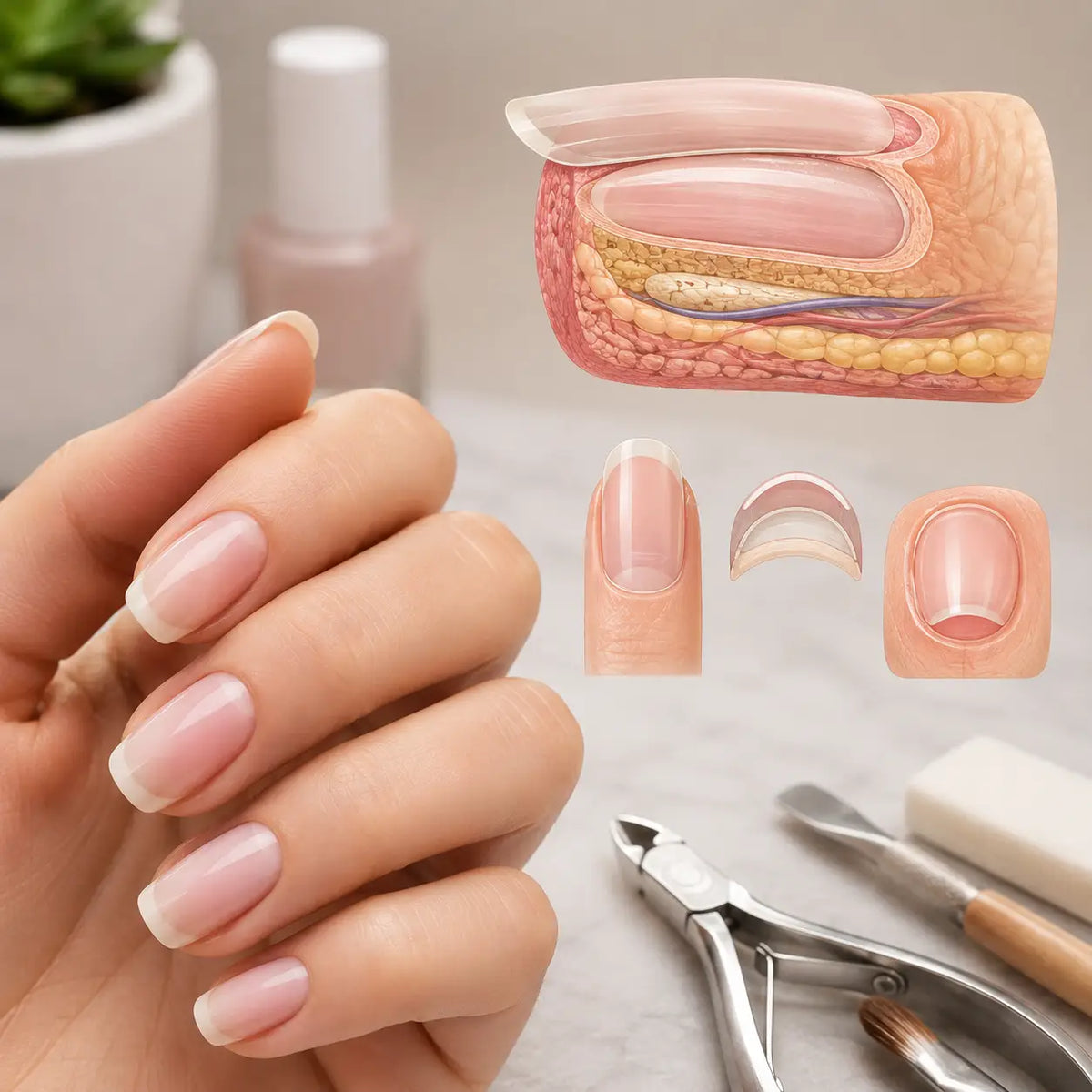
Nails look simple.
They're small, flat, and usually covered with polish, gel, acrylic, or another beautiful finish. But underneath that finished look is a surprisingly complex structure.
For nail technicians, understanding the natural nail isn't just interesting trivia. It helps explain why proper preparation, the right tools, and appropriate nail products matter so much.
Here are seven interesting things about nail structure that clients may not know.
1. The Nail Plate Isn't the Whole Nail
When someone says "nail," they're usually talking about the hard surface they can see.
That's the nail plate.
But the nail plate is only one part of the overall nail unit. Under and around it are structures including the nail bed, matrix, cuticle area, nail folds, and other supporting tissues.
Think of the visible nail plate as the part of a much larger system that happens to be easiest to see.
This is one reason professional nail care requires more than simply applying a product to the surface.
2. Your Nail Is Made of Layers
The nail plate is primarily composed of keratin, a tough structural protein also found in hair and the outer layer of skin.
But the plate itself isn't just one perfectly uniform slab.
It contains multiple layers of tightly packed keratinized cells.
This layered structure helps give the nail its strength while still allowing some flexibility.
That's also why aggressive filing or excessive removal can change how a natural nail feels.
The nail isn't an unlimited canvas.
It has a structure that needs to be respected.
3. The Part You See Growing Out Is Already Formed
Here's a fun one.
The visible nail plate is made of cells that have already undergone keratinization.
The active growth process happens primarily farther back, in the nail matrix, which sits beneath the skin near the base of the nail.
As new nail cells are produced and mature, they contribute to the nail plate and push the existing plate forward.
So when you look at your nails growing longer, you're essentially watching newly produced nail material gradually move the older nail plate toward the free edge.
The nail grows from the back—not from the tip.
4. The Lunula Is Only the Tip of Something Bigger
That little pale half-moon sometimes visible near the base of the nail is called the lunula.
It is the visible portion of the nail matrix in many people.
But here's the interesting part: you don't necessarily see the lunula on every finger.
It can be more noticeable on some nails and barely visible or absent on others.
So if someone has tiny lunulas—or can't see them at all—it doesn't automatically mean something is wrong.
Nail anatomy has plenty of natural variation.
5. The Cuticle and Nail Fold Aren't the Same Thing
These terms are often used interchangeably in everyday conversation, but technically they're different structures.
The cuticle refers to a thin layer of dead tissue that can adhere to the nail plate near its base.
The proximal nail fold, on the other hand, is living skin that surrounds the base of the nail.
That distinction matters during professional nail preparation.
Technicians need to work carefully around living tissue rather than treating everything around the nail as something that should simply be removed.
This is one reason controlled technique matters just as much as having good tools.
6. The Free Edge Is the Part That Gets All the Attention
The free edge is the portion of the nail plate that extends beyond the fingertip.
It's also the part that clients tend to notice when choosing a nail shape.
Square.
Oval.
Almond.
Coffin.
Stiletto.
But the free edge isn't just about aesthetics.
Its length and shape influence how the nail interacts with everyday activities and how enhancements are constructed.
That's why nail technicians consider the natural nail's structure when shaping and building enhancements.
A beautiful shape still needs to make sense for the individual nail and the client's lifestyle.
7. Your Nails Aren't Just Decorative
Perhaps the biggest piece of trivia is also the easiest to overlook.
Fingernails provide protection for the sensitive fingertips and contribute to fine touch and manipulation.
They also give technicians an important surface on which to perform cosmetic services.
That means nail care isn't simply about making the nails look pretty.
It's about working with an existing biological structure.
And that is why professional nail services require thoughtful preparation rather than a one-size-fits-all approach.
Why Nail Structure Matters at the Salon
Knowing these seven facts makes one thing clear:
The natural nail is more complicated than it looks.
A technician who understands the nail structure can make better decisions about preparation, shaping, product application, and removal.
That knowledge also explains why professional-quality tools and products matter.
The Right Prep Starts With Understanding
Before applying polish, gel, acrylic, or another enhancement, technicians need to prepare the nail appropriately.
Different services have different preparation requirements.
A good preparation routine may involve cleansing, shaping, cuticle-area preparation, and other steps designed for the specific service.
The objective isn't to change the natural nail unnecessarily.
It's to create an appropriate foundation for the service.
Tools Matter More When You're Working With Precision
A cuticle pusher might look like a very basic tool.
A nail file might seem like something anyone can use.
But professional technicians know that small differences in tool quality, shape, balance, and control can affect the work.
When you're working within a few millimeters of living skin, precision matters.
That makes professional nail implements an important part of the workstation.
Different Nails Can Need Different Approaches
Not every client's nails are identical.
Nails vary in thickness, shape, length, flexibility, and overall condition.
That's another reason technicians shouldn't approach every appointment with exactly the same routine.
Understanding nail anatomy gives professionals a foundation for adapting their techniques and selecting appropriate products.
The goal is not simply to follow a fixed sequence.
It's to understand why each step is being performed.
Nail Knowledge Can Improve the Client Experience
There is also a business advantage to understanding nail structure.
Clients often have questions.
Why can't you file this thinner?
Why does my nail feel different after removing product?
Why do you spend so much time preparing the cuticle area?
Why can't we use the same technique on every nail?
A knowledgeable technician can explain the reasoning behind the service.
That can build confidence and help clients appreciate the work that happens before the final polish is applied.
The Products Become Easier to Understand
Once clients understand that the natural nail has different structures and needs, professional products make more sense too.
Prep products have a purpose.
Cuticle tools have a purpose.
Files and buffers have different roles.
Base products provide a foundation.
Enhancement products provide structure or appearance.
Finishing products complete the surface.
The service becomes easier to appreciate when clients understand that every product isn't simply another bottle on the table.
A Little Anatomy Goes a Long Way
Nail structure might sound like something reserved for a textbook.
But for nail technicians, it's practical knowledge.
The better you understand what you're working on, the more intelligently you can approach preparation, application, shaping, and removal.
And that knowledge ultimately supports one of the most important goals of professional nail care:
creating beautiful results while respecting the natural nail underneath.
Final Thoughts
The natural nail may look like a simple piece of keratin, but there's much more going on beneath the surface.
The nail plate, matrix, nail bed, cuticle, nail folds, lunula, and free edge all play different roles in the overall nail unit.
Understanding those structures gives nail technicians a better foundation for choosing appropriate techniques, tools, and products.
For clients, it reveals something equally interesting:
A professional manicure isn't just about what gets put on the nail. It's also about understanding what's already there.
And sometimes, the best-looking manicure starts with knowing the anatomy underneath it.