 Gel Polish
 Nail Lacquer
 Acrylic
 Nail Tools
 LED Lamps
 Pedicure Chairs
 Nail Art
 Furniture
The Secret Life of a Nail File: Why Grit Numbers Matter More Than You Think
August 31, 2026
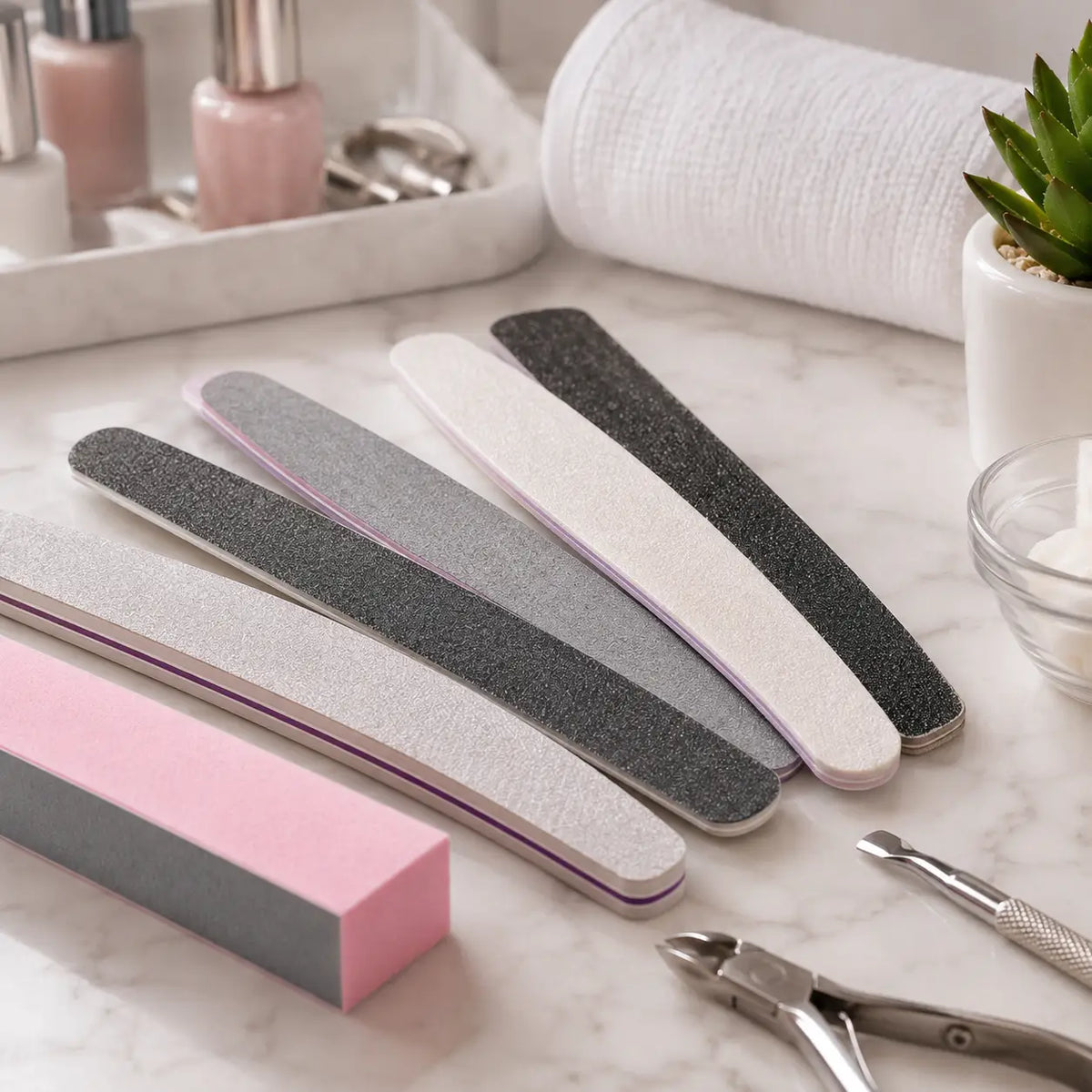
A nail file looks like one of the simplest tools in a salon.
It's usually just a flat surface with a textured side.
Yet ask an experienced nail technician about files, and suddenly things get much more complicated.
What grit is it?
Is it coarse or fine?
Is it for natural nails or enhancements?
Is it for shaping, refining, or finishing?
Why does one file feel almost rough enough to sand furniture while another feels surprisingly smooth?
The answer is in the grit number.
And once you understand what those numbers mean, you'll never look at a nail file quite the same way again.
What Does "Grit" Actually Mean?
Grit refers to the relative coarseness or fineness of the abrasive surface on a nail file.
In general, a lower grit number means a coarser abrasive, while a higher grit number means a finer abrasive.
Think of it like sandpaper.
A coarse surface removes material more aggressively.
A fine surface removes less material and allows for more controlled refining.
That simple difference is why salons keep multiple files instead of using one file for every job.
Why Can't One File Do Everything?
Imagine trying to polish a piece of wood using only very coarse sandpaper.
You might remove material quickly, but you wouldn't necessarily end up with a smooth finish.
The same basic idea applies to nail files.
A coarse file can be useful when substantial shaping or product reduction is required, particularly with artificial enhancements.
But using an unnecessarily coarse abrasive on a natural nail can be far too aggressive.
A finer file, meanwhile, gives the technician more control when refining edges and finishing the surface.
The right file depends on the job.
Lower Grit Means More Aggressive Filing
A lower-grit file generally has a more aggressive abrasive surface.
That can make it useful for tasks such as shaping artificial nail enhancements or reducing product thickness when appropriate.
For example, files in the rougher range may be useful when working with materials such as acrylic or certain enhancement systems.
But aggressive doesn't mean better.
A technician shouldn't automatically reach for the roughest file available simply because it works faster.
The goal is controlled removal.
Higher Grit Means Finer Control
As the grit number increases, the abrasive becomes finer.
That makes higher-grit files useful for more delicate refining and finishing tasks.
Instead of removing a lot of material quickly, the technician can make smaller adjustments.
This is particularly useful when working close to the final shape or refining the appearance of an enhancement.
It's the difference between sculpting and polishing.
Both are important.
They simply require different levels of aggression.
Natural Nails Need Special Consideration
One of the most important things about grit is that natural nails are not the same as artificial enhancements.
The natural nail plate is a living person's biological structure, even though the visible plate itself consists of hardened keratinized cells.
Using an excessively coarse abrasive on the natural nail can cause unnecessary thinning or surface damage.
That's why technicians generally choose files appropriate for the natural nail and use controlled pressure.
More filing isn't automatically better preparation.
Professional nail care is about knowing when to stop.
Enhancement Products Are Different
Artificial nail enhancements provide a different working surface.
Acrylic, hard gel, builder products, and other enhancement materials can require more substantial shaping than a natural nail.
That's where coarser files can become extremely useful.
A technician may need to establish the overall shape, refine the structure, or reduce product in specific areas.
The file becomes a shaping tool rather than simply something used to shorten nails.
And that's where having the correct grit can make a technician's work much more efficient.
The Same Nail Can Need Different Grits
Here's something clients may not realize.
A technician may use more than one file during a single service.
A coarser abrasive might be used for initial shaping.
A medium grit may then refine the form.
A finer grit can be used for finishing.
This progression makes sense because the job changes as the nail gets closer to its final appearance.
You don't necessarily want to use the same abrasive for every stage.
Grit Numbers Are a Technician's Shortcut
Instead of having to describe every file as "a little rough," "medium rough," or "very smooth," grit numbers provide a convenient way to identify abrasive characteristics.
A technician can quickly select the type of file appropriate for the task.
That saves time and makes a professional workstation easier to organize.
It also explains why a salon may have an entire collection of files that, to a client, appear almost identical.
They aren't identical.
They have different jobs.
Double-Sided Files Can Be Surprisingly Useful
Many professional nail files have different grits on opposite sides.
That gives the technician two abrasive surfaces in one tool.
For example, one side may be more aggressive for shaping while the other provides a finer surface for refining.
It's a simple design feature, but it can make a workstation more efficient.
Instead of reaching for another tool immediately, the technician can switch sides depending on the task.
The Shape of the File Matters Too
Grit isn't the only thing that makes a good nail file.
The physical shape and construction of the file also matter.
A straight file can be useful for creating or refining certain shapes.
A curved or smaller file may provide better access around particular areas.
A flexible file can feel different from a rigid one.
Different materials can also produce different filing experiences.
So choosing a file isn't simply about asking, "What grit is this?"
It's also about asking:
"What am I trying to accomplish?"
Too Much Pressure Can Defeat the Purpose
Even the perfect grit can be used incorrectly.
Pressing harder doesn't necessarily make filing better.
Excessive pressure can remove more material than intended and make it harder to control the final shape.
Experienced technicians learn to let the abrasive do the work while maintaining deliberate movements.
The file should be a precision instrument—not a power tool.
Why Professional Files Feel Different
Clients sometimes notice that professional nail technicians seem to work faster while still maintaining control.
Part of that comes from experience.
But the tools matter too.
A file with consistent abrasive quality can behave more predictably.
When the technician knows how the file will respond, they can make more confident movements.
That's particularly valuable during shaping, where small differences can affect symmetry.
Filing Is Part Technique, Part Tool Selection
A great nail file can't replace good technique.
Likewise, great technique becomes harder when the wrong tool is being used.
The two work together.
The technician needs to understand:
- The nail material
- The amount of product that needs to be removed
- The desired shape
- The appropriate grit
- The amount of pressure required
- When to switch to a finer abrasive
That's what separates professional filing from simply rubbing a rough surface against a nail.
A Simple Grit Guide
While exact recommendations can vary by product and manufacturer, a general way to think about nail file grits is:
Coarse grits:
Useful for substantial shaping or reducing artificial enhancement material when appropriate.
Medium grits:
Useful for general shaping and refining of enhancements.
Fine grits:
Useful for smoothing and finishing tasks where less aggressive abrasion is needed.
Very fine grits and buffers:
Used for delicate finishing and polishing-type work depending on the specific tool.
The important rule is simple:
Choose the least aggressive abrasive that can accomplish the job effectively.
The File Is Doing More Than You Think
When you watch a technician file a nail, it can look repetitive.
Back and forth.
Back and forth.
But each movement is changing something.
The length.
The sidewalls.
The free edge.
The apex.
The surface.
The overall shape.
The file is essentially a miniature shaping tool.
And the grit determines how aggressively that tool interacts with the material.
Why Salons Need a Variety of Files
A professional salon shouldn't expect one file to handle every situation.
Different services require different tools.
A natural manicure may require one type of abrasive.
Acrylic enhancements may require another.
Detailed finishing may require something finer.
Having an assortment of professional files allows technicians to choose the appropriate tool instead of forcing one abrasive to do every job.
That can improve both efficiency and precision.
Files Are Consumable Tools
Another important part of professional nail care is knowing when a file has reached the end of its useful life.
Abrasive surfaces can wear down with use.
As the file becomes less effective, the technician may have to apply more pressure or spend more time achieving the same result.
Replacing worn files helps maintain consistent performance.
For salons, that makes file inventory an important part of everyday workstation management.
A Small Investment Can Save Time
Nail files aren't usually the most expensive items in a salon.
But their impact on workflow can be significant.
A file that performs consistently can help a technician shape efficiently.
A file with the right grit can reduce unnecessary passes.
A file designed for the specific service can make the work more predictable.
Over dozens of appointments, those small efficiencies can add up.
The Client Sees the Shape—Not the File
Here's the funny part.
Clients rarely compliment the file.
They compliment the result.
"Your shape is perfect."
"How did you get them so even?"
"These look so smooth."
The tool itself stays in the background.
But that doesn't make it unimportant.
The file is one of the instruments responsible for creating the shape that everyone notices.
Final Thoughts
A nail file may look simple, but grit numbers reveal just how specialized this everyday salon tool can be.
Lower grits generally provide more aggressive abrasion, while higher grits offer finer control. Different nail materials and different stages of a service require different approaches.
For technicians, understanding grit helps make filing more controlled, efficient, and appropriate for the task.
For salons, keeping a variety of quality files available means technicians aren't forced to make one tool do everything.
And for clients, the next time you see a technician reach for a particular file, remember:
They aren't just picking up a piece of sandpaper. They're choosing the right level of precision for the job.