 Gel Polish
 Nail Lacquer
 Acrylic
 Nail Tools
 LED Lamps
 Pedicure Chairs
 Nail Art
 Furniture
The Strength Behind the Length: How Professional Nail Extension Products Help Create Longer-Lasting, Beautiful Enhancements
October 03, 2026
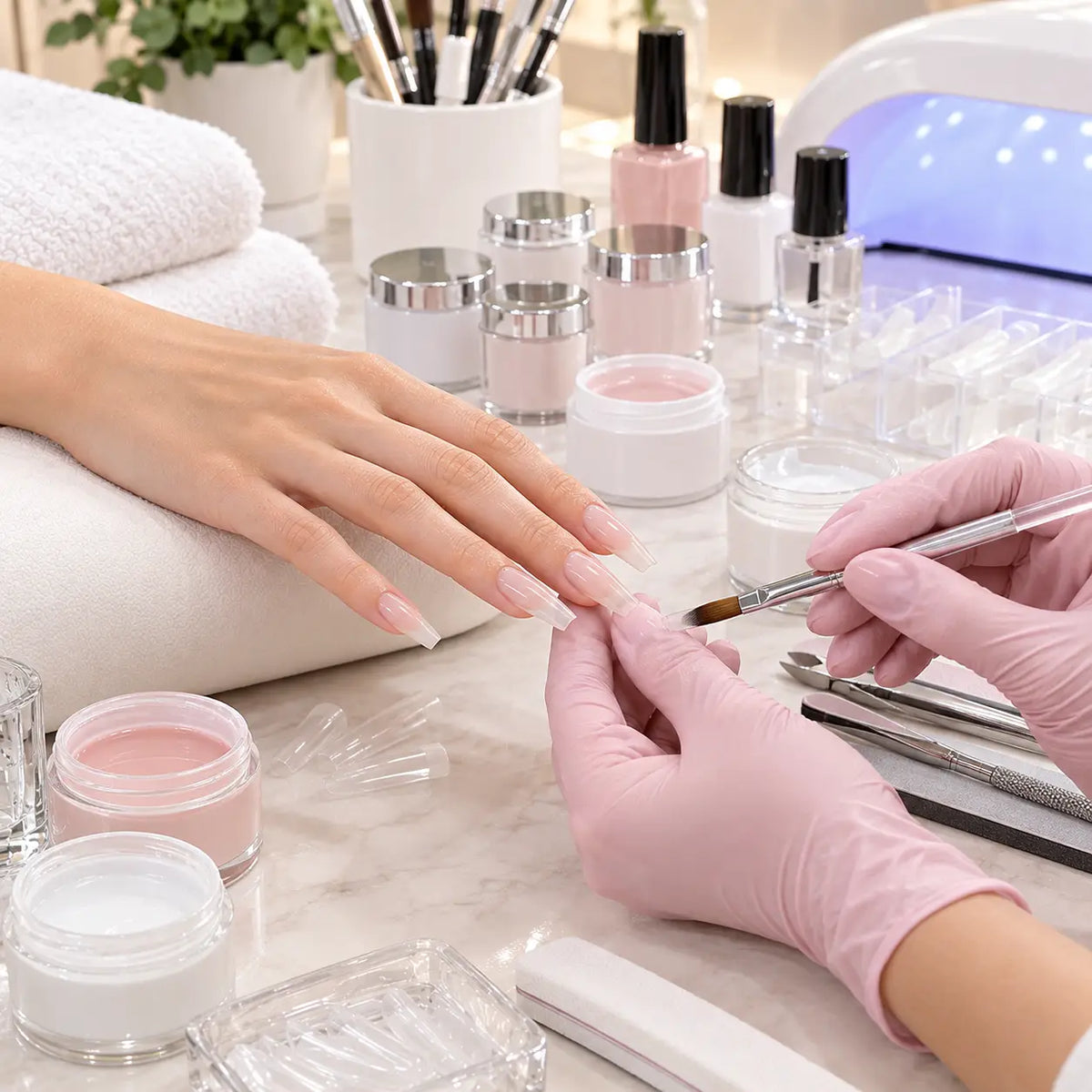
Long, beautifully shaped nails can transform the entire look of a manicure. Whether a client prefers elegant almond extensions, dramatic coffin nails, or timeless square tips, the finished result depends on much more than length alone.
Behind every beautiful extension is a combination of structure, preparation, product selection, and professional technique.
A nail extension must look attractive, but it also needs to be appropriately shaped, balanced, and suitable for the client's natural nails and lifestyle. Achieving that combination requires the right professional products and tools.
For nail technicians, understanding how extension gels, acrylic systems, nail tips, forms, primers, and finishing products work together can make a significant difference in the service.
Because the secret to beautiful extensions isn't simply making nails longer—it's building them correctly from the start.
1. Great Extensions Begin With Proper Preparation
Before adding length, nail technicians need to prepare the natural nail appropriately.
Preparation helps establish a suitable foundation for the chosen extension system. Depending on the product and service, this may involve cleansing, removing surface residue, carefully managing the cuticle area, and following the manufacturer's recommended preparation procedure.
Professional nail brushes, files, cleansers, and cuticle tools can help technicians perform these steps with greater control.
However, preparation should never mean aggressively thinning or damaging the natural nail. Excessive filing can weaken the nail plate and compromise the client's nail health.
The goal is to prepare the nail without unnecessarily removing its natural structure.
Even premium extension products cannot compensate for poor preparation, which is why this first step deserves as much attention as the extension application itself.
2. Choose the Right Extension System
Not every extension service uses the same products.
Different systems offer different application characteristics, working times, and finishing possibilities. Choosing the right one depends on the technician's skills, the client's preferences, and the intended result.
Common professional options include:
-
Acrylic systems: Combine acrylic powder with the appropriate liquid monomer to create a workable enhancement material.
-
Builder and extension gels: Use a compatible gel system to build or extend the nail, following the product's curing requirements.
-
Soft gel tips: Provide pre-shaped extensions that are attached using a compatible adhesive gel system.
-
Traditional nail tips: Create additional length using tips secured with an appropriate nail-tip adhesive, followed by the compatible enhancement or finishing process when required.
-
Nail forms: Help technicians sculpt an extension by providing a temporary guide for building the desired length and shape.
Each system has its place.
A technician who understands the characteristics of each option can recommend an appropriate service rather than relying on one method for every client.
3. Nail Tips and Forms Create the Foundation for Length
Adding length requires a stable foundation.
Nail tips and nail forms serve different purposes, but both help technicians establish the extension's shape and proportions.
Traditional tips provide a preformed structure that can be blended and enhanced according to the system being used. Forms allow the technician to sculpt the extension beyond the natural nail's edge.
The choice can influence the overall application process and the shapes that are practical to create.
Quality tips should suit the natural nail's width and curvature. A poorly fitting tip may create gaps, pressure points, or an awkward transition.
Forms also need to be positioned carefully so the extension can be built with the intended alignment and shape.
The better the foundation, the easier it is to create a balanced extension.
4. Acrylic Powder and Monomer: A Partnership That Matters
For acrylic extensions, powder and liquid monomer work together to form the material used to sculpt the enhancement.
These components need to be compatible and used according to the manufacturer's instructions.
Their interaction influences how the material behaves during application, including how it can be picked up, placed, shaped, and allowed to set.
For technicians, consistency matters.
A product that behaves predictably makes it easier to control placement and work efficiently. Inconsistent application can lead to uneven surfaces, unnecessary filing, and additional corrections.
Proper ratios, suitable working conditions, and familiarity with the specific system all contribute to better control.
Quality acrylic products are valuable not simply because they help create length, but because their working characteristics can support a more consistent professional process.
5. Extension Gels Need the Right Application and Curing
Gel extension systems offer another route to creating sculpted enhancements.
Depending on the formulation, these products may be used to build structure, extend the nail, or attach compatible extension tips.
The gel must be applied according to its intended use and cured using the lamp type, wavelength, and curing schedule specified by the manufacturer.
This is particularly important because a surface that appears hard does not necessarily mean the material underneath has cured adequately.
Incorrect curing can compromise product performance and increase the risk of skin sensitization.
Technicians should avoid skin contact with uncured gel, use compatible products and equipment, and never assume that a longer curing time will correct every curing problem.
Selecting a suitable extension gel is therefore only part of the equation. Correct application and curing are equally important.
6. The Apex: A Small Detail With a Big Job
One of the most important structural considerations in nail extensions is the apex—the appropriately positioned area of added thickness that helps support the enhancement.
It is not simply a bump added to make the nail thicker.
Its position and shape depend on factors such as the extension's length, shape, product system, and overall architecture.
A properly constructed enhancement distributes material in a way that supports the nail's structure while maintaining an attractive profile.
Too little structure in a demanding area may leave the extension more vulnerable to stress. Excessive thickness, on the other hand, can make the nail look bulky and poorly balanced.
This is why professional sculpting products and application techniques matter.
The goal is to create an extension that looks elegant from above and has an appropriately balanced profile from the side.
7. Longer Nails Require More Attention to Structure
A longer extension can create greater leverage when the free edge catches against something.
That means additional length can increase the forces acting on the enhancement and its connection to the natural nail.
Simply adding more product everywhere is not the solution.
Instead, technicians need to consider the intended length, shape, stress areas, and characteristics of the chosen extension system.
A dramatic extension may require a different structural approach from a short, natural-looking enhancement.
This is also why clients should receive realistic recommendations about length and maintenance based on their preferences and daily activities.
A beautiful extension should be designed for the client—not just for the photograph.
8. Nail Files and E-Files Help Refine the Shape
Once the extension material has been applied and properly set or cured, shaping helps transform the structure into the intended design.
Professional hand files are useful for refining the sidewalls, free edge, surface, and overall silhouette.
Electric nail files can also assist trained technicians with appropriate refinement tasks when used with the correct bit, speed, pressure, and technique.
The key is control.
Excessive filing can thin the enhancement, damage the natural nail, or generate unnecessary heat. An e-file should never be used aggressively simply to speed through a service.
Different tools are designed for different jobs, and choosing the appropriate file or bit can make the process more precise.
A well-shaped extension should look balanced from multiple angles, with consistent contours and clean edges.
9. Primers and Bonding Products Need Compatibility
Primers and other preparation or bonding products can play a role in certain extension systems.
However, their use depends on the specific products involved.
Some systems require a particular primer or bonding agent, while others specify different preparation steps. Applying additional products indiscriminately does not automatically improve adhesion.
Incompatible combinations can interfere with product performance or introduce unnecessary steps.
Technicians should follow the complete system's directions rather than mixing products based on assumptions.
A reliable extension service comes from understanding what each product is designed to do—and using it where appropriate.
10. Smooth Application Reduces Unnecessary Filing
One of the biggest time-saving advantages of controlled application is that it can reduce the amount of corrective filing needed afterward.
When enhancement material is placed evenly and shaped with intention, technicians spend less time correcting bulky areas, uneven surfaces, and awkward transitions.
Product consistency can make this process easier.
Materials that behave predictably allow technicians to develop a repeatable application technique, although the ideal consistency varies between product systems.
The objective is not to eliminate all finishing work.
It is to apply the product well enough that finishing becomes a refinement step rather than a rescue mission.
For a busy salon, that can help make services more efficient without sacrificing attention to detail.
11. The Final Layer Brings Everything Together
Once the extension has been shaped and refined, the finishing stage determines much of its final appearance.
Depending on the system, this may involve color, a compatible top coat, finishing gel, or another specified finishing product.
A high-quality finishing layer can enhance gloss, create a more uniform appearance, and help complete the design.
But a glossy top coat cannot correct every structural problem underneath it.
Uneven shaping, poor application, and rough contours can still affect the final result.
The best finish comes from combining good structure with controlled application and appropriate finishing products.
For clients who prefer understated nails, a smooth, high-shine finish may be all the decoration they need.
For others, the extension becomes a canvas for French tips, chrome effects, nail art, or more elaborate designs.
12. Beautiful Extensions Also Need Maintenance
Even well-constructed extensions require ongoing maintenance.
As natural nails grow, the position of the enhancement's balance point changes relative to the natural nail. The regrowth area becomes more noticeable, and the original structure may no longer be ideally positioned for the extension's length.
Regular professional maintenance allows the technician to assess the enhancement, manage regrowth, and determine whether a refill, reshaping, replacement, or removal is appropriate.
Clients should also understand that extensions are not indestructible.
Using nails as tools, picking at lifting product, or ignoring damage can increase the risk of breakage or injury.
If an extension becomes painful, separates significantly, or reveals concerning changes in the natural nail, it should be assessed rather than simply covered with more product.
Good aftercare supports the appearance of the manicure while helping clients recognize when professional attention is needed.
13. Build a Professional Extension Kit That Works Together
For salon owners and nail technicians, stocking extension products is about more than collecting individual items.
The products need to support the actual services offered.
A professional extension workstation may include:
-
Compatible extension gels or acrylic powder and monomer
-
Suitable nail tips or sculpting forms
-
Required primers, bonders, or preparation products
-
Appropriate files and buffers
-
Cuticle preparation tools
-
Brushes suited to the chosen system
-
A compatible curing lamp for gel products
-
Finishing gels or top coats
-
Cleansing and cleanup supplies
-
Suitable maintenance and removal products
Not every service needs every item.
The most useful collection is one that supports the technician's preferred systems, provides reliable options for different clients, and avoids unnecessary product mixing.
Choosing compatible products can also simplify training, inventory management, and the application process.
14. Quality Products Help Support Consistent Salon Results
Clients may choose extensions because they want longer nails, but they often judge the result by more than length.
They notice whether the shape suits their hands, whether the surface looks smooth, whether the finish is attractive, and whether the nails feel comfortable.
Consistent products can help technicians reproduce the working process needed to achieve those results.
This doesn't mean that the most expensive product automatically produces the best extension. Suitability, compatibility, correct technique, and adherence to manufacturer instructions all matter.
For salon owners, the smartest purchasing decision is to choose products that perform reliably for the services being offered.
When the materials, tools, and techniques work together, the technician can focus on precision rather than constantly compensating for unpredictable products.
Final Thoughts
Beautiful nail extensions begin long before the final color or glossy finish.
Preparation creates the foundation. Tips and forms help establish length. Acrylics and gels provide the enhancement material. Compatible bonding products support the chosen system. Files and e-files refine the shape. Finishing products bring the look together.
Each step contributes to the overall result.
For nail professionals, investing in suitable extension products and dependable tools can support a more consistent workflow and help create enhancements that look balanced, polished, and appropriate for the client.
The real selling point isn't simply longer nails.
It is the combination of attractive design, thoughtful structure, professional application, and reliable maintenance.
Because when the foundation is right, beautiful length becomes more than a look—it becomes a professionally crafted enhancement.