 Gel Polish
 Nail Lacquer
 Acrylic
 Nail Tools
 LED Lamps
 Pedicure Chairs
 Nail Art
 Furniture
Nail Lamp Trivia: 7 Things You Probably Didn't Know About UV/LED Nail Lamps
August 14, 2026
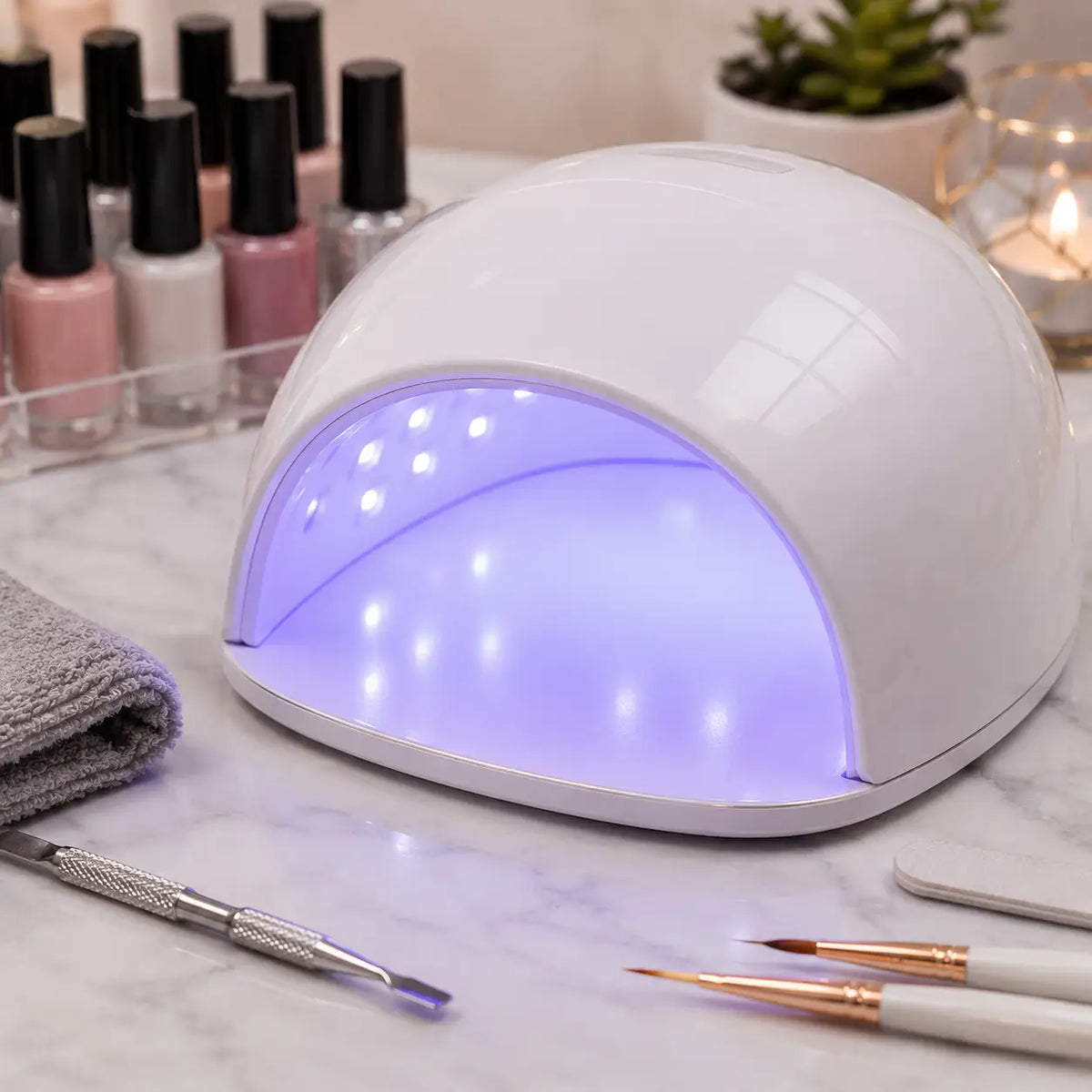
When most people think about a nail lamp, they probably picture a simple device that a technician places over the hand during a gel manicure.
The light comes on, the timer counts down, and the product cures.
Simple, right?
There's actually more going on inside that little lamp than most clients realize. From the type of light it produces to the way the hand is positioned inside it, several factors can influence how well a gel product cures.
Here are seven interesting facts about UV/LED nail lamps that might make you look at the nail table a little differently.
1. LED Nail Lamps Still Use UV Light
One of the most common misconceptions is that LED nail lamps and UV lamps are completely different types of light.
The "LED" part actually refers to the light-emitting diode technology used to produce the light.
Many modern LED nail lamps emit ultraviolet light within wavelengths used to cure compatible gel products.
So the difference isn't simply "UV versus no UV."
It's more about the technology used to generate the curing light and the wavelengths produced.
2. Not Every Gel Cures Under Every Lamp
This is one of the most important facts for anyone using professional gel products.
Gel products contain photoinitiators that respond to specific wavelengths of light.
That means a gel product and a lamp need to be compatible.
A lamp can turn on perfectly and still not be the ideal curing device for a particular gel system.
That's why manufacturers provide recommended curing times and lamp requirements for their products.
The brightest-looking lamp isn't automatically the best choice.
Compatibility matters.
3. More Light Doesn't Always Mean a Faster Cure
It might seem logical that increasing the light intensity would simply make every gel cure faster.
But curing chemistry isn't quite that simple.
The formulation of the gel, the wavelengths emitted by the lamp, the intensity of the light, the distance between the light source and the product, and the recommended curing time can all influence the result.
Trying to shorten curing time simply because a lamp appears powerful isn't necessarily a good idea.
Following the product manufacturer's curing instructions is far more important.
4. Your Hand Position Can Actually Matter
A nail lamp isn't just about switching the light on.
Where the nails sit inside the lamp can affect how much light reaches different areas.
If a finger is positioned too far forward, tilted, or outside the intended curing area, some parts of the nail may receive less exposure.
This is particularly relevant with longer nails, sculpted extensions, or designs with unusual shapes.
Technicians may need to pay attention to positioning to ensure the entire nail receives appropriate exposure.
A few centimeters can make more difference than people expect.
5. Those Timers Are More Important Than They Look
The timer on a professional nail lamp isn't merely a convenience.
It helps technicians deliver a consistent curing cycle.
Instead of manually guessing when enough time has passed, the technician can select the appropriate setting and maintain a more repeatable process.
Some lamps offer several preset curing times, while others include additional modes designed around particular product systems or client comfort.
A small button on the lamp can therefore play an important role in maintaining consistency.
6. Some Lamps Are Designed to Reduce the "Heat Spike"
Have you ever heard a client say that their nails suddenly feel hot inside the lamp?
This can happen during the curing process because gel products release heat as they polymerize.
Some lamp designs include low-heat or gradual-power modes intended to make the curing experience more comfortable.
These modes don't eliminate the chemistry taking place inside the gel.
Instead, they can alter how the lamp delivers its light during the curing cycle.
For clients who are particularly sensitive to heat during curing, this can be a useful feature to consider.
7. The Lamp Is Only One Part of the Curing System
Perhaps the biggest misconception is that the lamp itself determines whether a manicure cures properly.
In reality, the lamp is only one part of the equation.
The product formulation matters.
The thickness of the application matters.
The recommended curing time matters.
The lamp's wavelength and intensity matter.
Even the positioning of the nail matters.
Think of it as a partnership between the product and the equipment.
A high-quality lamp cannot compensate for applying a gel product incorrectly, and a compatible gel product still needs the appropriate curing conditions.
Why This Trivia Actually Matters
These facts may sound like technical details, but they have practical consequences in a professional nail salon.
Proper curing is an important part of working with gel systems.
Technicians need to understand their products and the equipment being used with them rather than assuming every lamp and every gel works exactly the same way.
That's why professional nail lamps have evolved beyond simply being boxes with lights.
Modern designs can include multiple curing modes, timers, sensors, ergonomic interiors, low-heat options, and different light configurations.
The goal is to make the curing process more controlled and consistent.
The Technology Behind the Shine
That beautiful glossy gel finish clients see at the end of a manicure isn't created by the lamp alone.
It's the result of chemistry, technique, product formulation, and properly selected equipment working together.
The lamp provides the energy needed to initiate the curing process, turning the liquid or semi-liquid gel coating into the hardened material that makes the finished manicure possible.
Once you understand what's happening inside the lamp, the device suddenly seems much more interesting than it first appears.
Final Thoughts
A nail lamp may spend most of its life sitting quietly on the nail table, but there's a surprising amount of technology behind that familiar glow.
UV and LED technology, curing wavelengths, product compatibility, hand positioning, timers, heat management, and gel chemistry all contribute to the final result.
So the next time a manicure disappears under a nail lamp, remember that it's not simply "drying."
A carefully controlled curing process is taking place.
And that little light on the nail table is doing much more than it appears to be.